Sourdough Boutique

Baking Dreams in Las Vegas. How Passion and Culture Brought Home Gold for Aruba

For thirteen years, she taught biology in Aruba, never imagining that one day, her name would be called on an international stage. Not for a scientific discovery, but for something far more aromatic. Bread.
After completing her Bread Sommelier training in Germany, she didn’t stop there. Her next destination? Las Vegas, where she would compete against bakers from around the world at one of the most prestigious bread competitions.

The Vegas Challenge
Unlike the Düsseldorf event, which tested theory and sensory skills, Las Vegas was all about the bread itself. Bakers entered their creations in multiple categories, and she entered four: sourdough, wholewheat, sweet showstopper, and burger bun.
“At first, I only wanted to join one category,” she recalls. “But then I thought, why not more? We’ve made so many special breads for restaurants back home so I decided to try.”
Each loaf was judged on appearance, aroma, sound (yes — how the crust cracks!), texture, and flavor. Out of all her entries, two stood out. Not just for taste, but for the stories they carried.

The Bread of Aruba
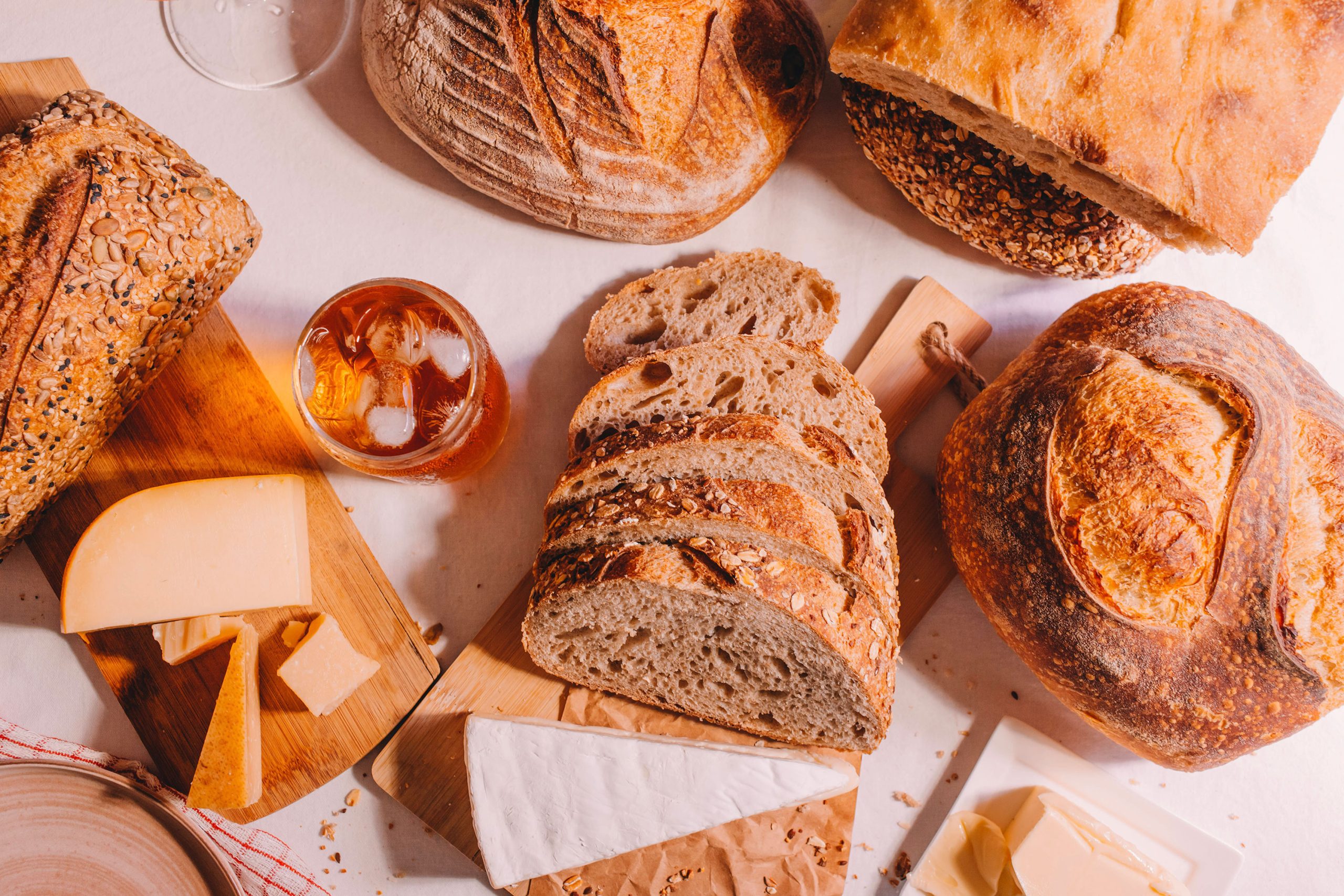
She won gold for her wholewheat bread. A recipe she developed herself, inspired by Aruba’s agricultural roots. “I wanted to create a bread that reflects the flavors and memories of my childhood. Caramel, vanilla, and the warmth of my grandmother’s kitchen,” she says.
During her studies, she discovered that sorghum, corn, and sugarcane, three crops once cultivated in Aruba are genetically related. “That’s when I thought, yes, this should be the Aruban bread.”
Her creation didn’t just win gold, it told a story of heritage, family, and island pride.

The Sunset Brioche
But there was more. Her bronze-winning brioche infused with turmeric, marigold, chamomile, and yellow lentils glowed with the color of an Aruban sunset. “When you slice it, it’s completely golden inside,” she smiles. “That’s why I named it The Sunset.”
Today, these breads have become bestsellers at her bakery, T2Pan. Locals ask for “the golden bread” by name, and the creations have even featured on restaurant menus. “People stop me in supermarkets to congratulate me,” she laughs. “Some say they taste cinnamon or sweetness, but it all comes from natural fermentation. That’s the magic.”

Beyond Awards — Building Bridges
Her victories didn’t just bring medals, they opened doors. A European flour company has since approached her for a possible partnership, and she’s been connecting with bakers worldwide eager to visit Aruba and collaborate.
“Representing Aruba on the world stage was incredible,” she says. “It showed that even a small island can inspire something big.”

From Classroom to World Stage. The Journey of Aruba’s Bread Sommelier

For thirteen years, she stood in front of a classroom, teaching biology to teenagers and encouraging them to explore the wonders of science. But somewhere between lesson plans and lab experiments, a quiet dream began to rise, one that smelled of freshly baked bread.
In 2019, she made a bold decision. “I realized I wasn’t getting the chance to grow further in my career,” she says. “At the same time, I was searching for a bread with high nutritional value for my children. That’s when I started baking.”
What began as a simple act of love, a mother baking healthy bread for her kids, soon turned into a passion that would take her across continents.

A New Chapter: Becoming a Bread Sommelier
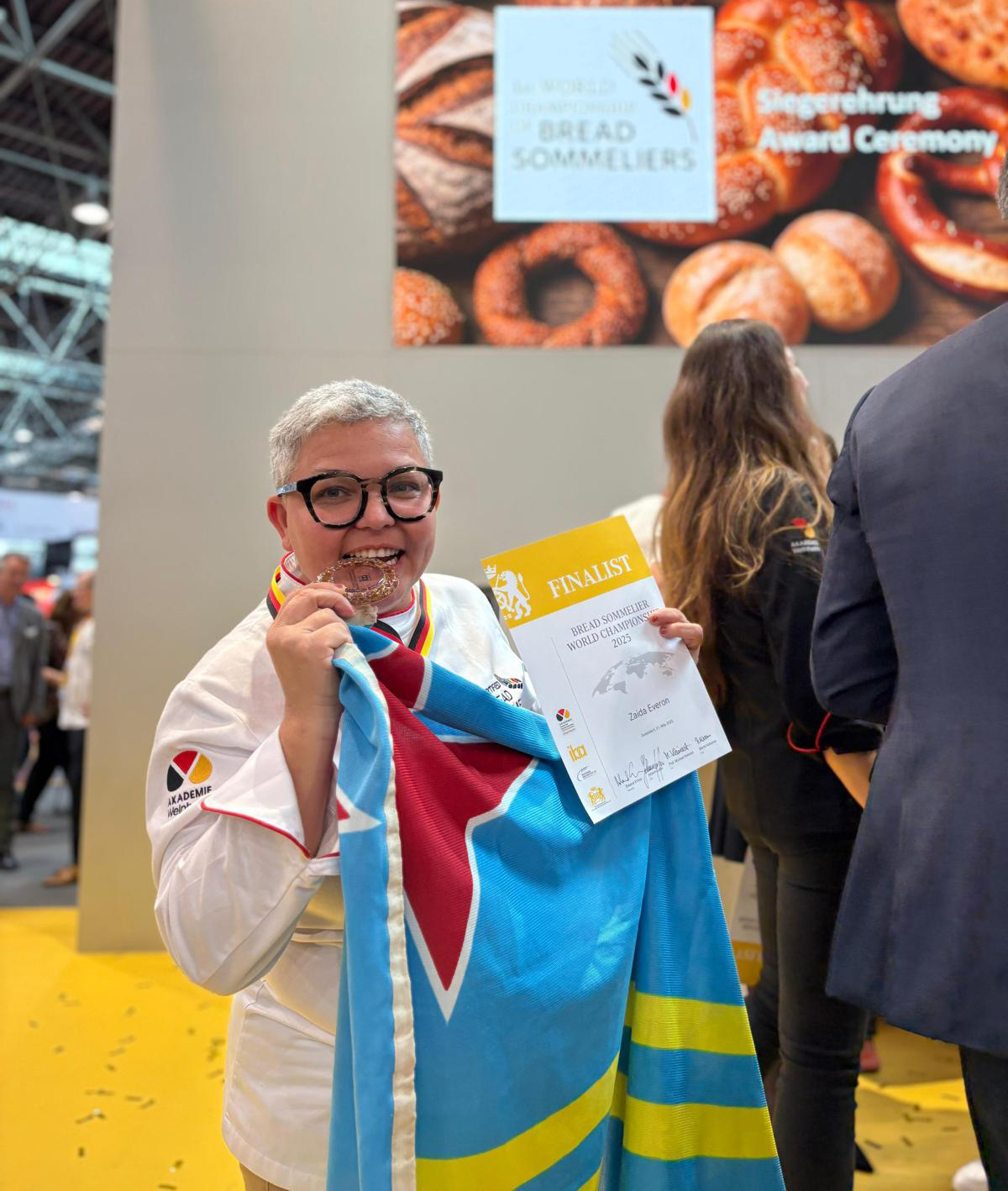
In Germany, a new profession had been gaining recognition, that of the Bread Sommelier, a specialist trained to understand bread the way wine sommeliers understand wines. By 2024, the first group of international Bread Sommeliers had been certified, and Zaida proudly stood among them. The only representative from the Caribbean.
“It’s a one-year program at the Bread Academy in Weinheim,” she explains. “We had to study the theory online, write a thesis, and then complete practical exams in person.”
Her curiosity about bread deepened. She was blown away by its history, its chemistry, its soul. She learned to recognize aromas, understand fermentation, and even trained her sense of smell with a kit of 52 different scents. “In the beginning, I got almost everything wrong,” she laughs. “But over time, I developed a ‘smell memory.’ Now I can recognize them instantly.”

The Championship in Düsseldorf
Then came the World Championship for Bread Sommeliers in Düsseldorf. The first of its kind. Forty-five participants from around the world competed, only sixteen advancing to the finals.
“We had to identify and describe breads from around the world, recognize aromas, answer historical and technical questions and finally, do a live tasting presentation before an audience.”
It was a male-dominated field, but that didn’t intimidate Zaida. “We were just five women among dozens of men. It was empowering. People were amazed to learn that someone from Aruba, a small island so far from Europe had such passion for bread.”
Her journey to Düsseldorf was more than a competition. It was a declaration: that passion, knowledge, and purpose can rise just like dough, from the most unexpected places.